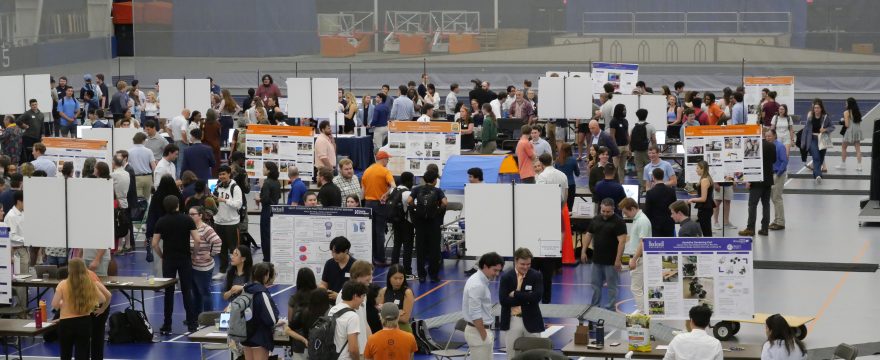
The 2026 Bucknell College of Engineering Design Expo is Friday, May 1, in Gerhard Fieldhouse. Below is a layout and listing of student teams participating in the Expo. You’re invited to scroll down this page to read more about the projects.
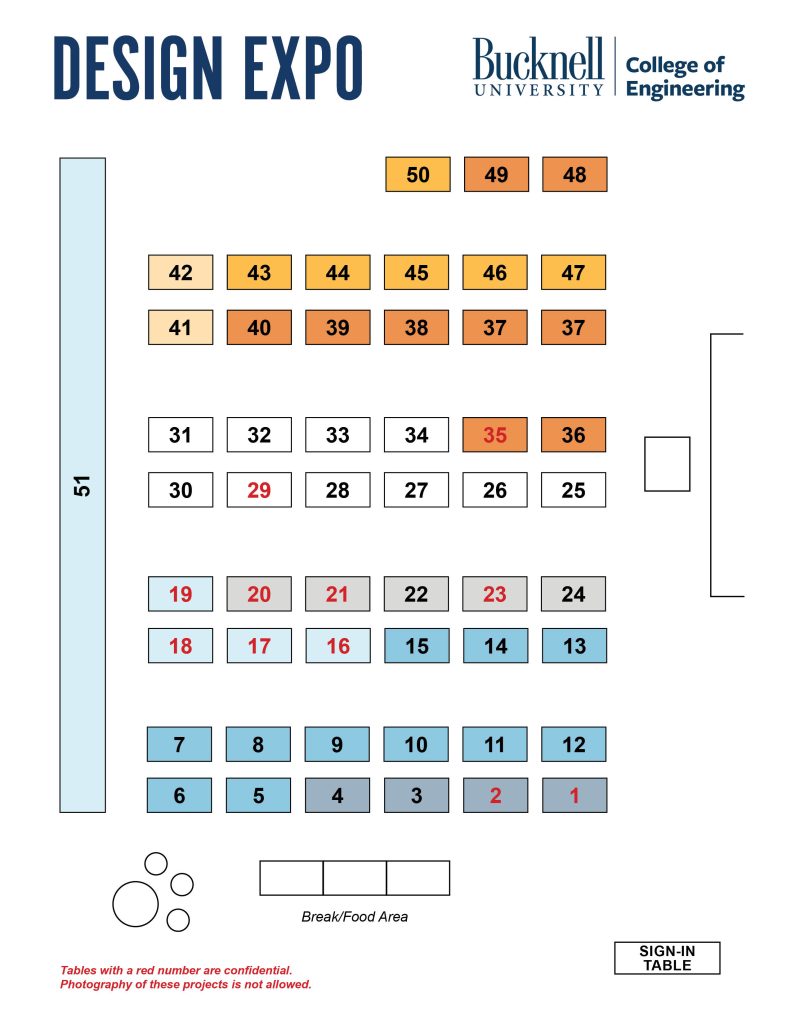
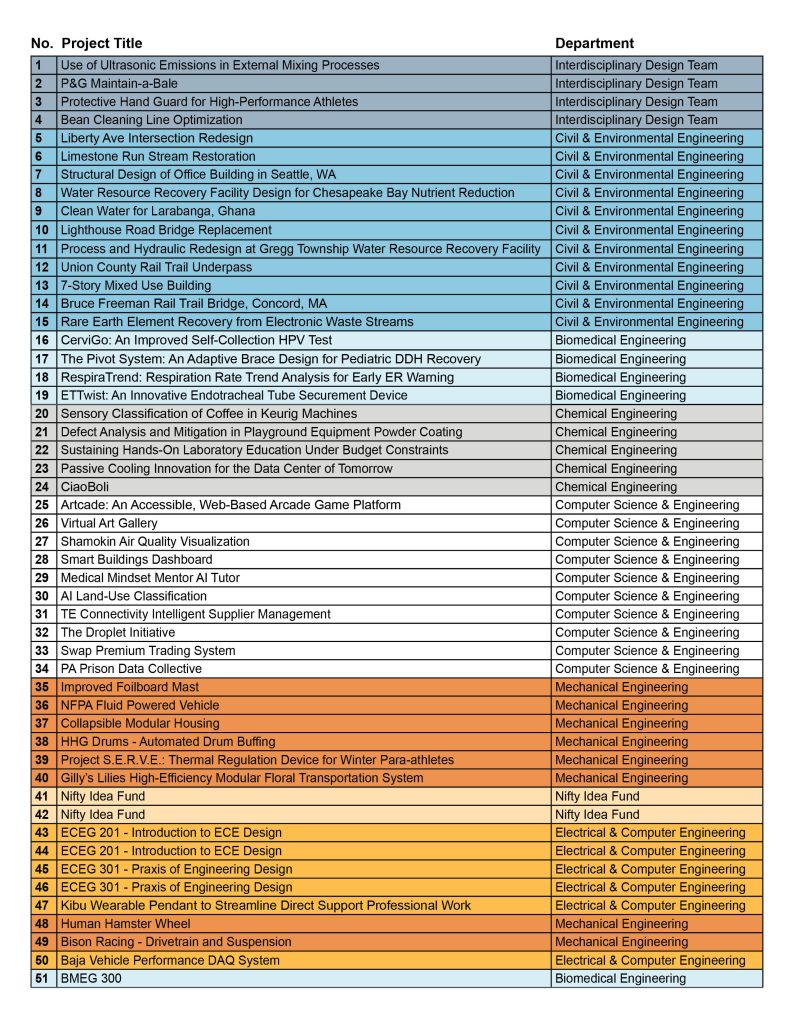
Projects marked with *** are confidential. There is no photography of confidential projects. Access to the Expo is restricted to those who have signed a non-disclosure agreement (NDA). Please sign the NDA form at the registration table upon entering the Expo.
Biomedical Engineering Projects | Chemical Engineering Projects | Civil and Environmental Engineering Projects | Computer Science Projects | Electrical and Computer Engineering Projects | Interdisciplinary Projects | Mechanical Engineering Projects | Nifty Idea Fund
Biomedical Engineering
BMEG 300 Posters
Aldo Castaneda, Samantha Cole, Ryane Fisahn, Jack Glennon, Isaac Horst, Paige Jackson, Mya Klaiber, Ryan Mittelman, Amani Ndegwa-Brown, Julia Piccolino, Lindsey Preston, Caroline Robitaille, Hannah Ruohoniemi, Angelina Santos, Jordan Son, Tanner Tighelaar, Anna Tsigler, Sean Tunnicliff, Sarah Zimmerman
Junior Biomedical Engineering students from BMEG 300 present posters of their final projects. Each student has independently developed a computational fluid dynamics model of a medically-relevant flow. The models represent a wide range of flows in the body and in medical devices, including some developed from CT scans.
CerviGo: An Improved Self-Collection HPV Test ***
Ivan Chan, Max Clark, Evvie Hergenhan, Andie McCullough
In-clinic self-collection HPV tests serve as a means of overcoming the many physical and psychological barriers associated with traditional cervical cancer screening methods, but such tests still pose concerns with regard to patient confidence. In response, we developed CerviGo, a device that interfaces with a clinically-used testing kit with the goal of improving the user’s confidence and comfort throughout the process.
ETTwist: An Innovative Endotracheal Tube Securement Device ***
Kelly Damore, Claire Hayes, Madeline Lehker, Elizabeth Malley
Unplanned extubation is the accidental or patient-initiated removal of an endotracheal tube. It is a life-threatening event for neonates in the NICU that can lead to severe hypoxia, trauma, and death. ETTwist addresses this clinical need with a revolutionary device for neonates that features a unique securement approach that capitalizes on tube securement, exceeding traditional methods used in the NICU.
RespiraTrend: Respiration Rate Trend Analysis for Early ER Warning ***
Uijin Kang, Connor Kozick, Min Sub Lee, Jackson Vinarub
RespiraTrend is a standalone device optimized for the fast-paced Emergency Department environment. It utilizes a chest-worn accelerometer and a peak detection algorithm to capture real-time respiratory data, which is then wirelessly transmitted to a dedicated bedside LCD screen. This provides clinicians with immediate, visual information on respiratory trends, facilitating the earlier detection of subtle physiological deterioration.
The Pivot System: An Adaptive Brace Design for Pediatric DDH Recovery ***
Will Colegrove, Joseph Guillen, Christopher Kirby, Abi Schwang
This project focuses on developing an improved hip abduction brace for treating developmental dysplasia of the hip (DDH) in children aged 1–3 years. The design aims to enhance comfort, mobility, and pressure distribution while maintaining effective joint positioning to improve patient compliance and clinical outcomes.
Chemical Engineering
CiaoBoli ***
Lyric Abdul-Rasheed, Sofia Guerra-Torres, Dominique Mahoner, Brayden Young
Analyzing and reducing excess liquid pooling in a frozen meat stromboli product. To ensure a crispy golden-brown crust and consistent flavor profile when cooked directly from frozen.
Defect Analysis and Mitigation in Playground Equipment Powder Coating ***
Victoria Burek, Will Feldscher, Meghan Herrold, Klio Kokolis
The colorful paint on playground parts is commonly applied via a process known as powder-coating. Playworld, a playground manufacturer, tasked our team with investigating the pre-treatment steps in their powder-coating lines.
Passive Cooling Innovation for the Data Center of Tomorrow ***
Zander Bauer, Sarina DeFinnis, John Kachurak, Omuhle Ndhlovu
The main goal of the Data Center Thermal Solutions project is to find out how using structural ceiling grid, wall partitions, and aisle containment coatings or similar materials can help improve thermal management in data center halls.
Sensory Classification of Coffee in Keurig Machines ***
Shane Coudriet, Josh Kearstan, Jolien Tran, Michael Trommer
Linking real measurable data to taste markers in cups of coffee. Working to establish what consumers want in nitro cold brew coffee.
Sustaining Hands-On Laboratory Education Under Budget Constraints
Carson Holloway, Christian Owens, Hayden Linkerhof
This project aimed to optimize moisture control in take-home frozen vegetable stromboli to prevent a soggy bottom crust and excess water release. By analyzing ingredient preparation, freezing methods, and food additives, our team developed a solution to enhance crust crispiness while preserving stromboli texture and flavor.
Civil and Environmental Engineering
7-Story Mixed Use Building
Jonathan Cabrera, Ryan Carson, Simon Martin
This team designed a 7-story mixed-use building located in the Boston area that contains both residential and commercial retail space.
Bruce Freeman Rail Trail Bridge, Concord MA
Jasmine Cruz, Mark Moreiras, Melisa Omerovic
This project seeks to connect disjointed segments of the Bruce Freeman Rail Trail Bridge in Concord, Massachusetts in order to provide safer pedestrian travel over the Route 2 highway.
Clean Water for Larabanga, Ghana
Alessia Cusick, Rhodenischelah Limage, Brennan Newcomb, Sean Oakey
In Northern Ghana, the Larabanga community faces a complex water scarcity challenge that calls for an innovative solution. Currently, the community faces severe water scarcity as residents rely heavily on distant, contaminated dams supplied by rainfalls during the wet season and external bagged water for drinking and household use. The lack of reliable safe and potable drinking water has led to a spread of diseases like cholera, dysentery, and typhoid fever. Our project through community interaction and outreach aims to help construct an adequately dug borehole well with a filtration system that can supply the community with potable water especially during the dry season.
Liberty Ave Intersection Redesign
Rebekah Lando, Victoria Miller-Tuchon, Connor Rogan
This project seeks to redesign a 5-way juncture at the foot of the Bloomfield Bridge located in Pittsburgh, PA. This redesign focuses on improving safety for users of all transportation modes and a cost estimate will be provided.
Lighthouse Road Bridge Replacement
Cristian Cruz, Nini Goguadze, Alexander Marks, Ronan O’Driscoll, Drew Pultz, Aiden Tacker
Our project involves the design of both the superstructure and substructure of a bridge replacement.
Limestone Run Stream Restoration
Mason Helms, Chris Khoury, Eva Shafer, Adam Walker
Our project is a stream restoration in Milton, PA, focused on improving water quality, stabilizing stream conditions, and restoring natural hydrologic function along Limestone Run. The design integrates floodplain reconnection, legacy sediment removal, wetlands, and community features such as trails, educational signage, and a nature-based play area.
Process and Hydraulic Redesign at Gregg Township Water Resource Recovery Facility
Jack Barnett-Mould, Luca Dowdall, Ford Matthews, Joshua Raeter
The redesign of a sequencing batch reactor water resource recovery facility to a continuous flow process with a membrane bioreactor.
Rare Earth Element Recovery from Electronic Waste Streams
Justin Coyle, Aidan Davie, Demi Gonzalez, and Isabel Ramos
A rare earth element recovery project was developed using locally sourced electronic waste, while employing biological processes to selectively separate and extract valuable rare minerals with reduced environmental impact compared to conventional methods such as mining.
Structural Design of Office Building in Seattle, Washington
Finn Atkins, Charlotte Olin, Emma Symonds
This project encompasses the structural design of a seven-story mixed-use office building in Seattle, Washington, utilizing a steel gravity system with a composite metal deck floor system. Lateral force resistance is provided by a steel moment-resisting frame, designed to meet the seismic and wind demands of the Pacific Northwest.
Union County Rail Trail Underpass
Jeremy Mann, Matt Rogers, Joshua Smith
Designing an underpass beneath Route 15 to connect both sides of the rail trail, providing a safer alternative for trail users.
Water Resource Recovery Facility Design for Chesapeake Bay Nutrient Reduction
Reagan Blackwell, Caryn Rippey, Livia Zlockie
Our team designed a water resource recovery facility for a rapidly growing community near the Potomac River, located in the Chesapeake Bay Watershed. Due to the sensitivity of the Bay to nutrients like nitrogen and phosphorus, our team has utilized cutting-edge enhanced biological nutrient removal technology to meet extremely low effluent permit limits to protect public health, safety, and welfare.
Computer Science and Engineering
AI Land-Use Classification
Josh Lee, David Maduike, An Ngo, Jeremy Nuzzolo, Jonas Scott, Rahul Sibal
This project uses AI to classify aerial images across the United States and identify trends in forest conditions and landscape change. The goal is to help forest representatives review imagery more efficiently and spot meaningful patterns at scale.
Artcade: An Accessible, Web-Based Arcade Game Platform
Jack Eaton, Miles Meloni, Miguel Muniz, Andrew Nejes, Hannah Tran
Artcade is a web-based arcade system designed to make game discovery and play more accessible through inclusive UX and customizable controls. It allows developers to easily showcase their games on a portable arcade platform while enabling users to seamlessly browse, launch, and interact with games—even offline.
Medical Mindset Mentor AI Tutor ***
Donovan Coleman, Mikey Myro, Ellyn Ngo, Caroline Sheffet, Ibrahim Tahir, Kathryn Wrynn
The Medical Mindset Mentor AI Tutor is a collaboration between Bucknell University and Geisinger Health System. The goal is to enhance how medical educators provide written feedback by applying Growth Mindset Language, a framework that focuses on effort, progress, and development rather than fixed ability.
PA Prison Data Collective
Alex Araki-Kurdyla, Anna Barrios, Grace Lukan, Holiness Kerandi, Tucker Kerman
The PA Prison Collective interrogates carceral data and algorithmic decision-making to reveal the human cost of Pennsylvania’s prison systems. We unite academic researchers and community members by creating a platform that visualizes the public data available by the PA Department of Corrections.
Shamokin Air Quality Visualization
Walker Allen, Jack Beneigh, Max Goldzweig, John Kirincich, Robert Lerner, Shane Monaghan, Samuel Tuffour
Designing a website and data pipeline for bringing air quality tracking to the people of the Shamokin region. Additionally, building a dashboard for researchers to easily view key air quality metrics.
Smart Buildings Dashboard
Amanda Agambire, Hanna Bingley, Nikita Bityutskiy, Ethan Dreese, Geoffrey Gaines, Kate Strong
Bucknell web application to help support research regarding Bucknell’s current and future energy usage.
Swap Premium Trading System
Chang Min Bark, Isabel Bohan, Nate Casara, Hung Pham, Farhaj Shahid
This project involves building a secure Python desktop application that demonstrates a patented machine-learning model for generating trading signals in government bond markets using historical Bloomberg data. The final product is a polished, client-facing demo that allows institutional investors to visualize, explore, and evaluate the model’s outputs prior to full deployment.
TE Connectivity Intelligent Supplier Management
Allison Flaherty, Ella Fleischer, Mateo Herrera, Mercy Ifiegbu, Casey King, Caroline Sheridan
The Intelligent Supplier Management system is an AI-driven platform developed for TE Connectivity that centralizes fragmented supplier data into a unified knowledge graph, enabling real-time insights through natural language queries and an analytics dashboard. The system improves supplier evaluation, ranking, and decision-making to enhance efficiency and transparency in global procurement.
The Droplet Initiative
Graham Billington, Lyman Brackett, Dylan Lange, Leo McMenimen, Mike Merola, Owen Reilly
Analyzing water droplet phase changes under controlled environments. We have utilized a streamlined data labeler -> ML pipeline.
Virtual Art Gallery
Muhammad Ahmed, Jason Chung, Andy Gao, Jean Marie Ngabonziza, Peter Johnstone, Titus Weng
A virtual art gallery is an online space where users can explore curated artworks from anywhere in the world through interactive digital displays. It offers an immersive experience with features like zoom, audio guides, and assistant that bring art to life beyond physical boundaries. It also serves as a marketplace, allowing visitors to discover and purchase art directly from artists and galleries.
Electrical & Computer Engineering
Baja Vehicle Performance DAQ System
Robert English, Sean Kucic, Trevor Lamb, Keenan LaMontagne, John Murphy, Gardy Philogene, Davidson Theosmy, Josh Wickert
We built a data acquisition system for the Bucknell Baja vehicle that collects and stores important performance data during testing, such as frame and suspension strain, engine speed, CVT behavior, temperature, and vehicle acceleration. This gives the Baja team real data to better understand how the car is performing, find problems, and make smarter improvements for future designs.
Kibu Wearable Pendant to Streamline Direct Support Professional Work
Yali Amsili, Rachel Griffin, Brennah Kennedy, Aaron Khasabo, Tobey Paccione, Connor Page, Eli Strausser, Zoya Zhang
The Kibu Pendant is a wearable device that automates the entry of daily activity data into audited Electronic Health Records (EHRs). By eliminating the need for Direct Support Professionals (DSPs) to manually type or write up shift notes, the Pendant ensures accurate compliance while allowing staff to remain focused on supporting individuals with intellectual and developmental disabilities (IDD) throughout their day.
ECEG 201 – Introduction to ECE Design
Michael Bednarek, Pamela Cruz Alvarez, Sammy DeGraaff, Mohammed-Mehdi Hamdaoui, Brooke Johnston, Sophia King, Josh Le Quang, Aiden Marchiori, Dante Mascio, Michael McCormack, Allen Offei-Koranteng, Tommy Pappas, Michael Parizhsky, William Rea, Nathaniel Saltsgiver, Alexi Yeo, Yohannes Zekiros
This introductory ECE design course covers the basics of electronic design focusing on fabrication, measurement, and professional communication. Students will design, fabricate, and test electronic circuits and learn standards for manufacturability and professional communication.
ECEG 301 – Praxis of Engineering Design
Mason Barlow, Kevin Bui, Genesis Evbenaye, Natalia Kraiker, Cyrus Kuhn, Duy Le, Faris Lutfi, Max Manicke, Amanda Ortiz, Brandon Prevuznak, Brian Rios-Saldivar, Kingleo Wu
ECEG 301 has students design minimum viable products to address a United Nations Sustainable Development Goal (UNSDG). This year three teams of students explored ideas around UNSDG #11 – Make cities and human settlements inclusive, safe, resilient and sustainable.
Interdisciplinary Design Teams
Bean Cleaning Line Optimization ***
James Giffen, Sean O’Connor, KJ Portillo, James Robinson
Our team designed and prototyped an aerodynamic sorting system to remove heterogeneous debris from raw agricultural products post-harvest. This physical separation solution improves factory processing efficiency, reduces machine downtime, and improves operator safety.
Use of Ultrasonic Emissions in External Mixing Processes ***
Anna Ottman, Aditya Pudasaini, Melissa Viellette, Ryan Zmarzlak
Investigating the feasibility of incorporating ultrasonic technology into glass manufacturing processes for Corning Inc through the design of a custom external testing setup.
P&G Maintain-a-Bale ***
Jesse Choate, Maya Fetzer, Kelly Interiano, Lauren Reaman, Michael Schmidt
Our team designed and prototyped an aerodynamic sorting system to remove heterogeneous debris from raw agricultural products post-harvest. This physical separation solution improves factory processing efficiency, reduces machine downtime, and improves operator safety.
Protective Hand Guard for High-Performance Athletes ***
Parker Jackson, Ryan Koes, Josh Lawrence, Angelica Nowak, Chiara Vessicchio
Scaphoid injuries in high-performance athletes are costly, potentially career-ending, and often go unprotected due to the bulkiness of existing guards. This project develops a lightweight, protective hand guard designed to minimize performance interference and encourage use during competition.
Mechanical Engineering
Bison Racing – Drivetrain and Suspension
Riley Bower, Erikson Brown, Alexander Crossing, Ryan Firko, Adrina Iachini, Caitlyn Maruyama, Matthew Raudabaugh
The Suspension and Drivetrain division of Bison Racing aims to enhance the 2026 off-road racing vehicle by completely redesigning the suspension system and making strategic modifications to the drivetrain. These changes will increase braking power, improve suspension response, and significantly improve the car’s durability when competing in harsh conditions.
Collapsible Modular Housing
Alex Dalton, Cam Lynch, George Palmiero, Daniel Sierk
Our team worked with Iron Valley Modular Construction to design a collapsible housing module. This design allows homes to be shipped from factories to build sites on a single-wide trailer, makes homes more affordable.
Gilly’s Lilies High-Efficiency Modular Floral Transportation System
Julia Fleur Carey, Ben Flaxman, Katie Lash, Finn Sposato
Design and manufacture a modular, semi-permanent transportation system for Gilly’s Lilies to safely and efficiently transport diverse floral arrangements. This solution maximizes space through flexibility and optimization, reducing product damage and transportation costs compared to existing market options.
HHG Drums – Automated Drum Buffing
Jamie Lickstein, Evan Miserendino, Jordin Ramirez, Oren Bukowski
HHG Drums is a local manufacturing company based in Hollidaysburg, PA. The Bucknell senior design team partnered with them to design and fabricate a custom automated system to buff drums, replacing a labor-intensive manual process with a more efficient and consistent solution.
Human Hamster Wheel
Jacob Reiner, Jack Borden, Ethan Firestein, Ryan Genel, and Matt Schearer
Our team was tasked with redesigning multiple subsystems of a human-hamster-wheel-shaved-ice-machine for the local small business Kinetic Kreations. This Krazy Kreation turns the mechanical power of human motion into a delightful sweet treat; fun for all ages!
Improved Foilboard Mast ***
Joshua Hauck, Kellen Paulsen, Christian Wodtke, Quinn Zabiegalski
Developed a hydrofoil mast which enables higher performance. The project integrated analysis, CAD, prototyping, and on-water testing to quantify performance gains.
NFPA Fluid Powered Vehicle
Sethumte Asamoah-Nani, Alex Fitzpatrick, Grant Kern, Sarah McClelland, Marissa Wolff, Aidan Wood
We designed and built a hydraulic tricycle that captures wasted kinetic energy and transforms it into a mechanical boost. Engineered for a multi-event collegiate competition, the bike showcases a complex integration of fluid power and electronic controls, moving beyond traditional chain-and-sprocket drive to hydraulic drivetrain technology.
Project S.E.R.V.E.: Thermal Regulation Device for Winter Para-athletes
Mert Guney, Jordan Kenton, Timothy Robertson, Macy Volp
Winter para-athletes need to regulate residual limb temperatures due to the reduced blood flow through the residual limb creating discomfort and pain during winter sports. Creating a thermal regulation device to warm residual limbs will help improve athletic performance and athlete comfort during competition and training.
Nifty Idea Fund Projects
Lyric Abdul-Rasheed, Richard Chi, Esar Elmofty, Andy Gao, James Giffen, Joseph Guillen, Kellan Guinn-Bailey, Evan Katz, Gabe Pecaitis, Gabe Rottet, Katie Vaccaro, Matt Wool
The Nifty Idea Fund strives to remove financial barriers so that students can pursue personal projects of a technical, fabrication, or making nature. Nifty Idea empowers students to embrace curiosity and explore concepts purely for the joy of making, while developing valuable skills in the context of an intrinsically motivating project.