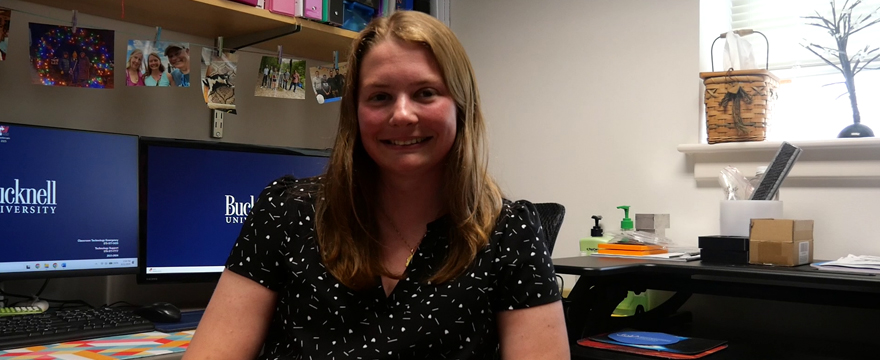
Bucknell Assistant Professor of Mechanical Engineering Elizabeth Mamros received a U.S. Fulbright Scholar Award and a Visiting Scholar Program Award from TU Chemnitz to spend the 2026-27 academic year conducting research in Germany. This is her second Fulbright Award, following one as a Ph.D. student at the University of New Hampshire in 2021-22. Elizabeth will be collaborating with a research colleague from her former Fulbright host institution, who she worked with in Dortmund, Germany, and has since moved to TU Chemnitz. Their research project focuses on incorporating heating during sheet metal forming processes to allow for the fabrication of high strength, lightweight components for the automotive and aerospace industries.
Elizabeth recently shared some perspectives on her Fulbright Award in a Q&A:
Q: What does it mean to be honored with a Fulbright Award for a second time?
A: It’s a really good opportunity to be a cultural ambassador and continue to serve in that role to strengthen the transatlantic relations between Germany and the U.S. I also get to make a difference in manufacturing and how that’s incorporated in my career and, moving forward, the kind of research area I want to focus on.
Q: What was your first Fulbright experience like as a Ph.D. student?
A: It was my first time living abroad that long. I spent 13 months in Dortmund, which is in western Germany. I was at the Institute of Forming Technology and Lightweight Components . It was a completely transformative experience being immersed in a different culture that pushed me outside of my comfort zone. It was a life-changing experience and a tremendous growth opportunity that inspired me to apply for a Fulbright again.
Q: What is it like to apply for the Fulbright?
A: It’s almost a year-long process. The biggest challenge is you have to have someone at a host institution that you’re going to work with, so you really need to have that connection. The application is due in September, and I learned in December that I had moved on to the international review process. Finally, I received notification in late April that I had been selected. It’s been a super quick turnaround to get everything lined up.
Q: What does it mean to participate in the Fulbright program as a professor after your experience as a Ph.D. student?
A: I’m really excited for it. I’m going to a completely different part of Germany. There’s one faculty member who I’m working with that I worked with previously in Dortmund, but other than that, it’s an all new team, new researchers, new research areas and equipment.
Q: What project were you working on during your last Fulbright?
A: I was working on incremental forming, which is one of the processes we’re going to focus on this time. We were looking at something called stress superposition, which is where you incorporate additional stresses during the forming process and try to change the properties of the part you’re making. I continued work on that for my doctoral thesis.
Q: What project will you be working on this time?
A: Incremental forming is a process that I’ve been working on and where my expertise is. But now we’re expanding that a little bit to look at spinning. It’s a similar process where you have a piece of sheet metal that’s clamped or a tube that is rotating at high speeds and then you’re using different tools to deform that tube or that sheet while it’s spinning. We’re going to introduce heat this time. So heat-assisted forming. It has a lot of applications in the aerospace and automotive industries as well as for making custom parts like implants.
Q: What higher level things will you be doing?
A: I’ve elevated my game a bit, for sure. One of the biggest step ups is now I’m going to be working with their research team, mentoring some of their students and hopefully getting some of our students involved when I come back. Part of the Visiting Scholar Program includes me giving guest lectures. That will be a new element for me.
Q: Are you looking forward to working with the same mentor from your previous Fulbright experience?
A: We had a great collaboration going in Dortmund. He sent a master’s student to the University of New Hampshire while I was there and we’ve kept in touch at conferences. We’re really looking forward to continuing our work together and hopefully continue to offer student opportunities.
Q: What does your day-to-day this coming year look like?
A: During the week, I’ll be in the lab quite a bit running experiments and simulations. They have specialized equipment and some different forming software that we don’t have here at Bucknell. I’ll be using it to run simulations on the experiments we’ll be working on. On the weekends, I’ll likely be traveling a lot. I found a great international hiking group during my previous Fulbright experience, so I’m hoping to find something similar this time.
Q: What do you expect to bring back to Bucknell?
A: I hope to bring some of their students over to visit and collaborate with our students on projects. I also hope to bring back some of the technologies I’ll be working with. I teach manufacturing processes for our juniors and an advanced manufacturing elective, so it will be good to be able to show them what these processes look like in a lab. I also hope to inspire them to pursue opportunities like Fulbright and go outside of their comfort zone to pursue their dreams.