Nearly a decade ago, Bucknell Professor of Mechanical Engineering Charles Kim participated in the NSF I-Corps program, an entrepreneurial training program that prepares scientists and engineers to extend their focus beyond the university laboratory to accelerate the economic and societal benefit of research projects that are ready to move toward commercialization. He long wanted to bring elements of the immersive program to Bucknell students.
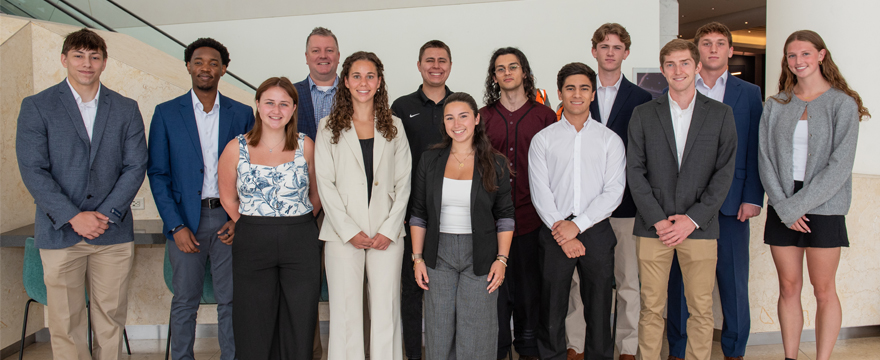
Fast forward a few years and Kim, along with Campbell Rutledge Jr. and Eleanor Rutledge Endowed Chair and Professor of Management and Entrepreneurship Bill Meek, recently completed the third summer of leading Bucknell’s on-campus MedTech Entrepreneurial Fellows Program. Students enrolled in the four-week program undergo a rapid experiential learning process for a real medical technology to determine if the idea has a market, using many components of the I-Corps program.
“The MedTech Program features a hypothesis-driven process that students test through interviews,” says Kim, who notes that all projects are under non-disclosure agreements to preserve future intellectual property filings. “Their goal is to better understand the financial and market side of technologies and identify a need. Groups are required to do a minimum of 30 interviews with relevant stakeholders to gain enough knowledge and determine if their initial hypothesis is correct.”
This year’s MedTech program featured 13 students, with 10 enrolled in the College of Engineering and three members of the Freeman College of Management. One of those students was Zoe Worchick ’29, a mechanical engineering major who started doing hands-on research with Kim in just her second semester on campus.
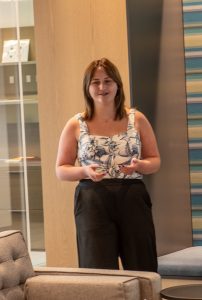
“Coming from an engineering background, I’m more focused on how I can solve a problem than if there is actually a problem,” says Worchick. “The MedTech program was interesting to me because we were finding out if people actually have this problem.”
Worchick’s group, which included fellow mechanical engineer Bernard Iringire Nkusi ’27 and biomedical engineers Aldo Castaneda ’27 and Gionni Carr ’29, interviewed more than 40 people during the first three weeks of the program.
“We had an idea in mind of what the problem was that we wanted to solve,” says Worchick. “We did a bunch of little shifts based on what we learned in interviews, but in the end we found that the problem we thought was a problem was an actual problem. In fact, we found that it was bigger than we thought it to be and it was impacting more than just one little part of their daily lives.”
The four-week program timeline seems daunting at first. Students conduct numerous interviews, have daily check-ins with Profs. Kim and Meek, attend workshops, create a prototype and present their ideas, all well before the Fourth of July.
“We started the program at five-and-a-half weeks in 2024 and are now at four weeks, which seems to be the sweet spot,” explains Kim. “If we put the expectation out that this work must be done rapidly, that they will have to get out of their comfort zones, and that they will have to be resourceful, students rise to the challenge. Some of our students are 18 or 19 years old. Requiring anyone to reach out to and talk to complete strangers can be a pretty daunting task at any age. It’s gratifying to see them develop as people through the program.”
Worchick heavily credits MedTech with pushing her out of her comfort zone. A self-described reserved person, she noted that asking people for 20 or 30 minutes of their time for an interview was extremely nerve-wracking. But, at the end of the program, her favorite thing was having the opportunity to talk with so many people.
“There’s something beautiful about being able to talk to people and have a real conversation and not be nervous about it,” says Worchick. “Once you do it, you realize how meaningful it is to talk to people and learn their perspectives.”
Student teams needed to synthesize each of the customer discovery interviews and compile the results. Worchick noted that her team moved their data from a Google Doc that was getting bogged down by too much information to another platform that could sufficiently handle it.
In the final week, teams developed a prototype, which doesn’t actually have to work—a pretendotype, which could be an app, something 3D printed or a wearable device. It is more a demonstration than a presentation of a product.
The final week wraps up with two presentation opportunities. The first is to a group of faculty on the Bucknell campus. The second is to a group of accomplished alumni in the Medtech field at LLR Partners in Philadelphia, hosted by Bucknell Board of Trustees member Scott Perricelli ‘94, P‘25. This year, the panel included Adam Glasofer ‘99, Chad Hellman ‘92 and Fracesca Joseph ‘01.
“We’re looking for them to develop new skills in presenting. The focus of the presentation is to communicate the market based on customer discovery interviews and to demonstrate what the product could be,” says Kim. “So, it’s not a technical presentation, per se.”
“Presenting was very scary, but once you practice and realize you’re the one who really knows what you’re talking about, you feel better,” says Worchick. “The audience was very knowledgeable, but our team truly holds the most knowledge about what we’re working on. Getting feedback from professors and the alumni in Philadelphia was really helpful and gave us things to think about this summer.”
While the MedTech program ended after the presentations in late June, Worchick is lucky to continue working on her team’s project alongside teammate Carr since they are both conducting research with Kim this summer.
“It’s really exciting to be able to continue because when we were first starting out I didn’t know what I was doing,” says Worchick. “I was still unsure and a little lost. But after the MedTech program it’s really hitting me how this technology could really help people.